
Mithridates VI Eupator (Mithdrates the Great) is the King of Pontus in northern Anatolia during 120-63 BC. He was the last Pontic ruler that goes by that name. He was known as one of the Roman Republic’s most formidable and successful enemies, who involved three of the prominent generals from the late Roman Republic in the Mithridatic Wars: Lucius Cornelius Sulla, Lucius and Gnaeus Rompey Magnus.
Background:
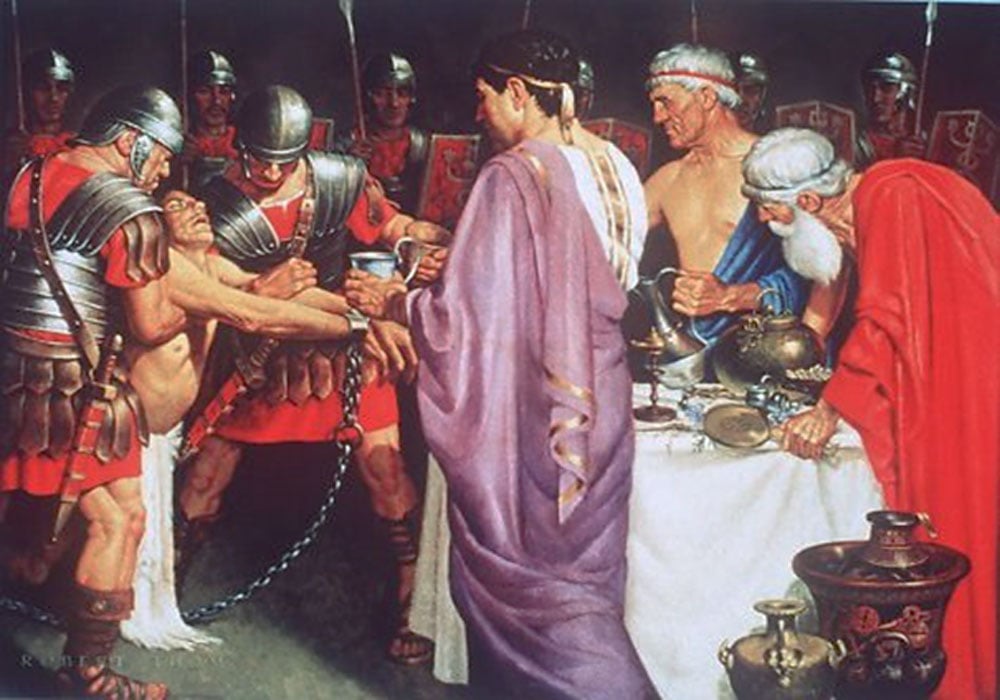
Mithridates VI inherited the throne after the death of his father, Mithridates V Euergetes. However, because he was a minor, the kingdom was ruled by a regent, Laodice VI, the mother of Mithridates VI. The death of his father was not of natural death, but resulted from assassination during 120 BC; poisoned at a lavished banquet he personally held. Poison was a standard political weapon. Mithridates VI “consumed various types of poison in small doses in order to develop immunity against them, should an assassin attempt to kill him by this means” (Dhwty). Furthermore, when he was young, “he dreamed of making himself immune to poisons, [and] after hundreds of experiments, Mithradates unlocked the pharmacological paradox still studied today: poisons can be benefical as well as lethical” (Mayor 26). His experiments was of “possibly poison nullifying substances on criminals condemned to death (presumably by poison)” (Flemming 458).
Roman admired Mithridates VI for his “courage and ideals left a wealth of biographical material scattered throughout many ancient tests: the king’s moods, jokes, speeches and dreams were recorded” (Mayor). Following Mithradates’ death, “his trademarked elixir was imbibed by Roman emperors, Chinese mandarins, and Euroepeans kings and queens, inspiring a flow of scientific treatises on the Poison King’s mastery of toxicology” (Mayor 26).

Mithridates announced himself as an enemy of Rome during the beginning of his reign and fought three separate wars against the Romans; constantly won against the Roman until he was crushed by Pompey the Great, after the betrayal by his son Pharnaces. Mithridatic Wars initialized from “much attention […] paid to the propagandistic struggle between Mithridates and Rome, since it was cruical to win the support of the Greek cities” (Hojte 8). The first Mithridatic War started well for the Mithridates since Roman were preoccupied against their Italian allies therefore, was unable to send full force to Asia Minor. In 87 BCE, Sulla was sent by Rome to “the front of five legions against Mithridates,” however, Mithridates were having internal civil unrest at home thus “negotiated the Peace of Dardanus with Sulla to end the conflict” (Mark). The second Mithridatic War was the invasion of Pontus by Murena when Mithridates was strengthing his army and power from the front of his army, but was defeated. The start of the third Mithridatic War was not as well as the first Mithridatic War. Although, “the Roman General Cotta was defeated easily,” Mithridates was overpowered by Lucius Licinus Lucullus and was driven “out of Bithynia” and Pontus was invaded (Mark).
Death of Mithridates VI
In the request for help heading towards his possessions around the Black Sea, Mithridates’ son Machares rejected him as he had an alliance with Rome, resulted in Mithridates killing his son. His other son, Pharnaces also “rebelled and led a force against” his own father “as Pompey was closing in” (Mark). He originally planned “an audacious land invasion of Italy over the Alps when he was betrayed by his son” (Mayor). He was left with no choice, but to commit suicide, “rather than be captured and paraded in a Roman triumph” (Mark). His daughters whom were besides him were killed with posion, by their father. He attempted to do the same “but failed and then asked a slave or servant to kill him” (Mark). The death of Mithridates VI in 63 BC, “Pompeius took the unusual step of giving his adversary a state funeral, [in] honour for one of the strongest opponents Rome had faced” (Hojte 12). He desired “to imitate Alexander the Great, who likewise had the body of his adversary buried in the tombs of his forefathers” (Hojte 12).
Temple of Artemis at Ephesus

Temple of Artemis also known as Artemisium, temple at Ephesus, was one of the Seven Wonders of the World. Artemesium was famous for being over 350 by 180 feet in size and its spectacular works of art. It was destroyed by the Goths in 262 AD; the destruction after 800 years later “had been completely forgotten by the people of the town that had once held it in such pride” (https://bit.ly/2J5nVvO).
Pontic Coinage

During the early third Mithridatic period in the Bosporan coinage intertwined with the establishment of Mithridates’ son as the ruler of Bosporos during the climax of the first war against Rome. There was an anti-Mithridatic movement in Bosporos during 80 BC, ceased by Mithridates VI, arranged Machares, his other son, to be the new ruler of Bosporos. Anonymous coins “were issued and circulated along with Pontic coins, consisting Sinopean tetrachalkoi of the later type ‘Zeus/eagle’.” (Hojte 243). During 65-63BC, the entire “Bosporan anonymous were overstruck on coins of Pantikapaion of the type ‘head of Apollon/eagle’ [and] almost all the Pantikapaian tetrachalkoi of this period of the type ‘head of Apollon/tripod’ were overstruck on Pontic coins of the type ‘Zeus/eage on thunderbolt'” (Hojte 243-244). Following Mithridates death, there was temporay no production of coins in brass and pure copper.
The coinage issued by Mithridates IV and with his Queen, sister-wife, Laodice, survived, and “according to the surviving coinage, his royal title and full name was Mithridates Philopator Philadelphus” (https://bit.ly/2Jm7Twh). The coinage issued with his wife expressed a “fine double portrait and […] adapted a Ptolemaic model for coinage” demonstrating attributes of Persian and Greek origins within the coin (https://bit.ly/2Jm7Twh).
Map of the Black Sea

During the autumn of 88 BC, 80,000 civilians were killed in Anatolia consisting of Roman and Italian merchants, slavetraders, and tax collectors; it was done by regular Anatolians, Greeks, Jews and other citizens of different cities. The plan was organized by Mithdrates VI; he “had envisioned a powerful empire, a co-prosperity zone with rich natural resources, to rival Rome’s expanding dominions” (Mayor). He arrived to Crimea, his Black Sea empire, and seek to continue the war with Rome, however because of the betrayal from his sons he killed his harem and daughter, and soon himself.
LINKS
- Readings and Study Guide
- Pontic Archaeology: The Temple of Artemis at Ephesus
- Pontic Coinage
- Pontic Maps and Landscapes
References
- Cn.worldheritage.org. (n.d.). World Heritage Encyclopedia. [online] Available at: http://cn.worldheritage.org/articles/eng/Mithridates_IV_of_Pontus [Accessed 2 Jul. 2019].
- Dhwty. “Mithridates VI of Pontus: The Poison King of Pontus and Aggravation to Rome.” Ancient Origins. September 18, 2018. Accessed July 02, 2019. https://www.ancient-origins.net/history-famous-people/mithridates-vi-pontus-poison-king-pontus-and-aggravation-rome-005907.
- Erskine, Andrew. A Companion to the Hellenistic World. Malden, MA: Blackwell, 2009.
- Højte, Jakob Munk. Mithridates VI and the Pontic Kingdom. Aarhus: Aarhus Univ. Press, 2009.
- Mark, Joshua J. “Mithridates VI.” Ancient History Encyclopedia. June 29, 2019. Accessed July 02, 2019. https://www.ancient.eu/Mithridates_VI/.
- Mayor, Adrienne. “Mithradates: Scourge of Rome.” History Today. Accessed July 03, 2019. https://www.historytoday.com/archive/mithradates-scourge-rome.
- Mayor, Adrienne. Poison King: The Life and Legend of Mithradates, Romes Deadliest Enemy. Princeton: Princeton Univ Press, 2011.
- Unmuseum.org. (n.d.). Temple at Ephesus. [online] Available at: http://www.unmuseum.org/mob/ephesus.htm [Accessed 2 Jul. 2019].
 Pontic Kingdom